
REx-PN
REx-PN vs NCLEX-PN: Which Exam Do Ontario and BC Practical Nurses Write?
By Nursing Elite Academy · · 8 min read
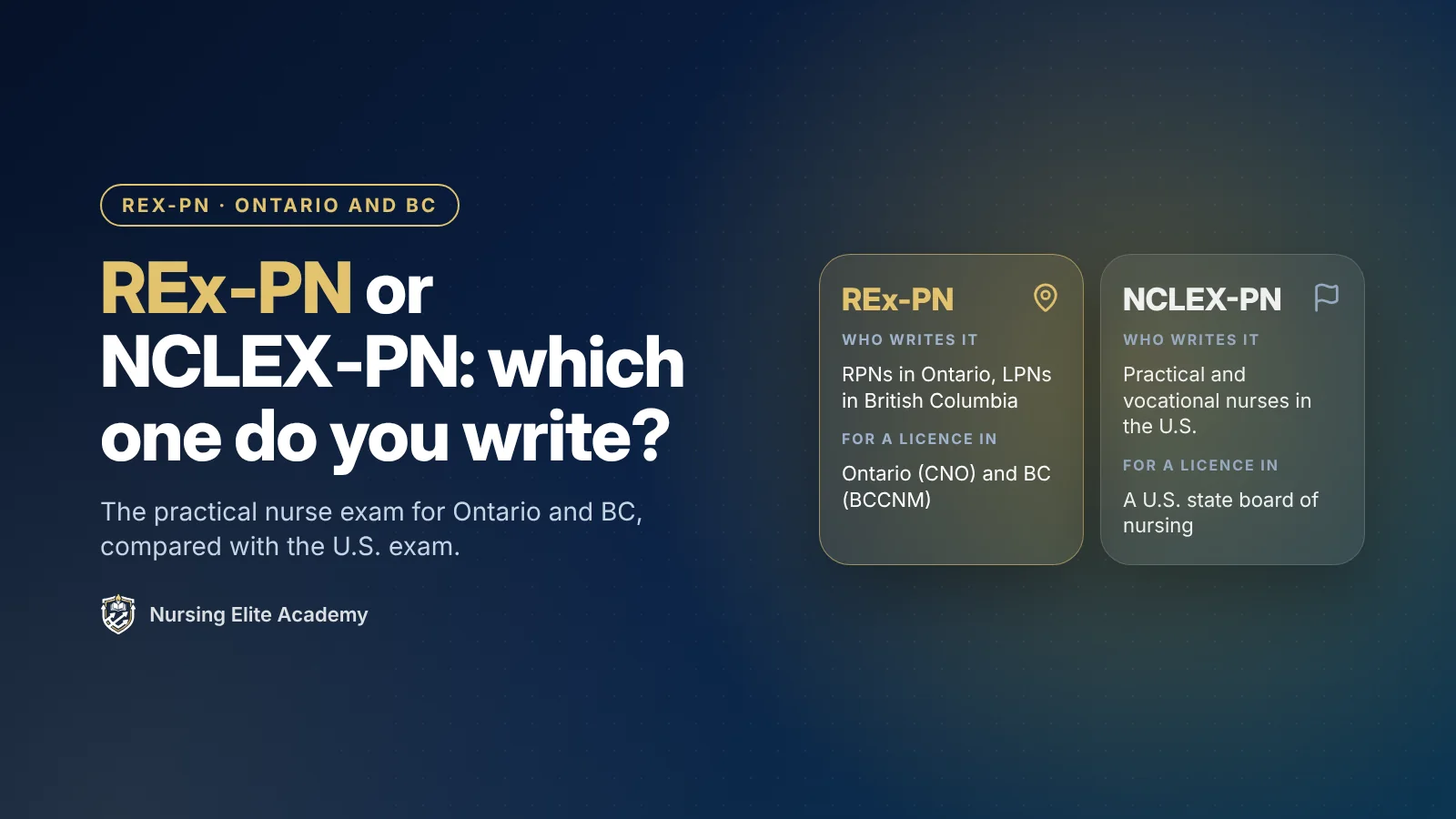
If you are finishing a practical nursing program in Ontario or British Columbia, or you are an internationally educated nurse applying to practise as a practical nurse there, you will hear about two exams with very similar names: the REx-PN and the NCLEX-PN. Both are built with the U.S.-based National Council of State Boards of Nursing (NCSBN), both are computerized adaptive tests and both are written at Pearson centres. They are not interchangeable, though. This guide compares REx-PN vs NCLEX-PN side by side, explains which one Ontario and BC regulators require, and shows how the differences should change the way you prepare.
The quick answer
To register as a Registered Practical Nurse (RPN) with the College of Nurses of Ontario (CNO) or as a Licensed Practical Nurse (LPN) with the BC College of Nurses and Midwives (BCCNM), you write the REx-PN. It has been Ontario's practical nurse registration exam since January 4, 2022, and it is used by both provinces. The NCLEX-PN is the licensure exam for practical and vocational nurses in the United States. You would write it if you were seeking a U.S. practical nurse licence through a U.S. board of nursing, not to register in Ontario or BC.
Other Canadian provinces and territories set their own practical nurse exam requirements, so if you plan to work elsewhere in Canada, check with that regulator directly.
What is the REx-PN?
The Regulatory Exam – Practical Nurse (REx-PN) was developed by NCSBN for CNO and BCCNM. According to CNO, nurses in Ontario and BC developed and reviewed its content, and a Canadian translation panel of French-speaking nurses reviewed the French version. The 2022 REx-PN Test Plan ties the exam to Ontario and BC entry-level competencies, provincial legislation and scope of practice. It uses Canadian terminology such as unregulated care provider, includes Indigenous health content, and its sample items use SI units such as degrees Celsius and mmol/L.
The REx-PN replaced the Canadian Practical Nurse Registration Exam (CPNRE) for new Ontario applicants. In BC, BCCNM says new practical nursing graduates must take the REx-PN, and only applicants already licensed in another jurisdiction can use CPNRE results to meet the exam requirement.
What is the NCLEX-PN?
The NCLEX-PN is NCSBN's licensure exam for entry-level practical and vocational nurses in the United States. Its current test plan took effect in April 2026. It shares the Next Generation NCLEX design with the NCLEX-RN, which means it includes clinical judgment case studies and stand-alone clinical judgment items such as bowtie and trend questions, alongside traditional items.
REx-PN vs NCLEX-PN: side-by-side
Who requires it
- REx-PN: CNO for Ontario RPNs and BCCNM for BC LPNs.
- NCLEX-PN: U.S. state and territorial boards of nursing for practical and vocational nurse licensure.
Length and time
- REx-PN: a minimum of 90 and a maximum of 150 questions, of which 30 are unscored pretest items. You have four hours in total, including the tutorial, sample items and optional breaks.
- NCLEX-PN (2026 test plan): a minimum of 85 and a maximum of 150 items, including 15 unscored pretest items and three case studies of six items each. You have five hours, including breaks.
Question types
- REx-PN: multiple choice, multiple response (select all that apply), fill-in-the-blank calculation, exhibit and graphic items. The current test plan does not include Next Generation case studies.
- NCLEX-PN: traditional items plus NGN case studies, bowtie, matrix, drop-down and other clinical judgment formats.
Scoring
- REx-PN: NCSBN's 2025 REx-PN webinar states that, effective January 2026, all items are scored correct or incorrect except multiple response select-all-that-apply items, which are scored for partial credit.
- NCLEX-PN: partial credit applies to every item with more than one key, using plus/minus, zero/one and rationale scoring.
How the exam ends
Both exams are computerized adaptive tests that use the same three stopping rules: the 95% confidence rule, the maximum-length rule and the run-out-of-time rule. In both, there is no fixed number of correct answers that equals a pass. The computer decides whether your ability is consistently above or below the passing standard, and you cannot go back to change an answer or skip a question.
Retakes
- REx-PN: no limit on attempts. You must wait at least 60 days between attempts, which CNO notes allows a maximum of six attempts a year. Each attempt gives you a different set of questions.
- NCLEX-PN: NCSBN policy allows a retake after 45 days, up to eight times a year, although individual boards can set stricter rules.
What changes next
REx-PN test plans are reviewed every five years. CNO has announced that the next REx-PN Test Plan takes effect on January 1, 2027, and a standard-setting panel of nurses from BC and Ontario was scheduled to meet in June 2026 to inform the passing standard for the following five years. If you are writing in 2027 or later, download the new test plan as soon as it is published and compare the content distribution with the 2022 version.
Where the content weight sits on the REx-PN
The 2022 REx-PN Test Plan organizes questions by client needs. The two heaviest areas are Management of Care at 18 to 24% and Pharmacological and Parenteral Therapies at 14 to 20%. Safety and Infection Control makes up 10 to 16%, Psychosocial Integrity and Reduction of Risk Potential 8 to 14% each, and Health Promotion and Maintenance, Basic Care and Comfort, and Physiological Adaptation 6 to 12% each. Individual exams can vary by up to 3% in each category. Build your study time around these weights rather than spreading it evenly.
How to prepare for the REx-PN
- Download the REx-PN Test Plan from your regulator and use the lab values list in it as your reference set.
- Complete the official candidate tutorial so the screen layout and item types are familiar before test day.
- Practise select-all-that-apply items carefully, since they are now the item type that earns partial credit and over-selecting can cost you.
- Rehearse drug calculations in SI units until they are automatic, because fill-in-the-blank calculation items give no options to check against.
- Study Ontario and BC practical nurse scope, delegation to unregulated care providers and when to consult a registered nurse, since Management of Care is the largest category.
- Do timed adaptive-style practice sets so four hours of continuous decisions feels manageable.
Booking and results
You book through Pearson only after your regulator confirms you are eligible and you receive your authorization to test. You can write at any Pearson Professional Assessments centre that offers the REx-PN, including centres outside Canada and the United States. BCCNM says you can reschedule up to 24 hours before your appointment, as long as the new date falls inside your authorization period. Results are pass or fail with no score; BCCNM says you usually receive them by email within a few days. If you do not pass, CNO sends a Candidate Performance Report showing whether you were above, near or below the passing standard in each area.
If you trained outside Canada, you will also have regulator and credential steps to complete before you can book. Our guide for internationally educated nurses walks through the wider pathway.
- REx-PN exam prep at Nursing Elite Academy
- Internationally educated nurses guide to working in Canada
- Start your REx-PN free trial
Sources
- College of Nurses of Ontario: REx-PN FAQs
- College of Nurses of Ontario: REx-PN, a new PN exam that reflects practice realities
- College of Nurses of Ontario: REx-PN standard setting panel (2027 test plan)
- BCCNM: REx-PN exam FAQs
- NCSBN: 2022 REx-PN Test Plan
- NCSBN: 2025 REx-PN test plan webinar (scoring change)
- NCSBN: NCLEX-PN Test Plan, effective April 2026
- NCLEX: Results and retake policy
Frequently asked questions
Do Ontario RPNs write the NCLEX-PN or the REx-PN?
Ontario RPN applicants write the REx-PN. It has been the College of Nurses of Ontario's practical nurse registration exam since January 4, 2022. The NCLEX-PN is used for practical nurse licensure in the United States.
Is the REx-PN harder than the NCLEX-PN?
Neither is officially rated as harder. They measure entry-level practical nursing ability against their own passing standards. The REx-PN is shorter in time (four hours versus five), uses traditional item types without NGN case studies, and reflects Ontario and BC practice.
How many questions are on the REx-PN?
The REx-PN has a minimum of 90 and a maximum of 150 questions, including 30 unscored pretest items. The computer stops once it can decide whether you are above or below the passing standard.
How often can I retake the REx-PN?
There is no limit on attempts, but you must wait at least 60 days between attempts, which works out to a maximum of six attempts a year. Each attempt gives you a different set of questions.
Does the REx-PN give partial credit?
According to NCSBN, from January 2026 multiple response select-all-that-apply items are scored for partial credit, while all other REx-PN items are scored as correct or incorrect.
Ready for your next nursing role?
Get a professionally written Canadian nursing resume, interview preparation and practical career guidance from Nursing Elite Academy.
Get Your Resume BuiltMore guides for nurses
- NCLEX-RNNCLEX-RN Quiz Builder & 7-Day Free Trial | Nursing Elite Academy
- NCLEX-RNHow to Pass the NCLEX-RN in 2027 (Canada & India Guide)
- NCLEX-RNBest NCLEX-RN Prep: Why Nurses Choose Nursing Elite Academy
- PSWNACC PSW Exam: Format, Pass Mark and How to Prepare
- NCLEX-RNNCLEX-RN Live Classes vs a Question Bank: Which Do You Need?
- NCLEX-RNHow NCLEX-RN Scoring Works (CAT, Partial Credit, Stopping Rules)
- NCLEXNGN NCLEX Tips: How to Prepare for the NCLEX-RN in Canada
- InterviewsCommon RPN Interview Questions and How to Answer Them
- ResumesNursing Resume Tips for Canada (RN, RPN & PSW)
- Internationally Educated NursesIEN Guide to Working as a Nurse in Canada
- GuidesHow to Verify a Registered Nurse in Canada