
NCLEX-RN
Live Classes vs. a Question Bank for the NCLEX-RN: Which Do You Need?
By Nursing Elite Academy · · 8 min read
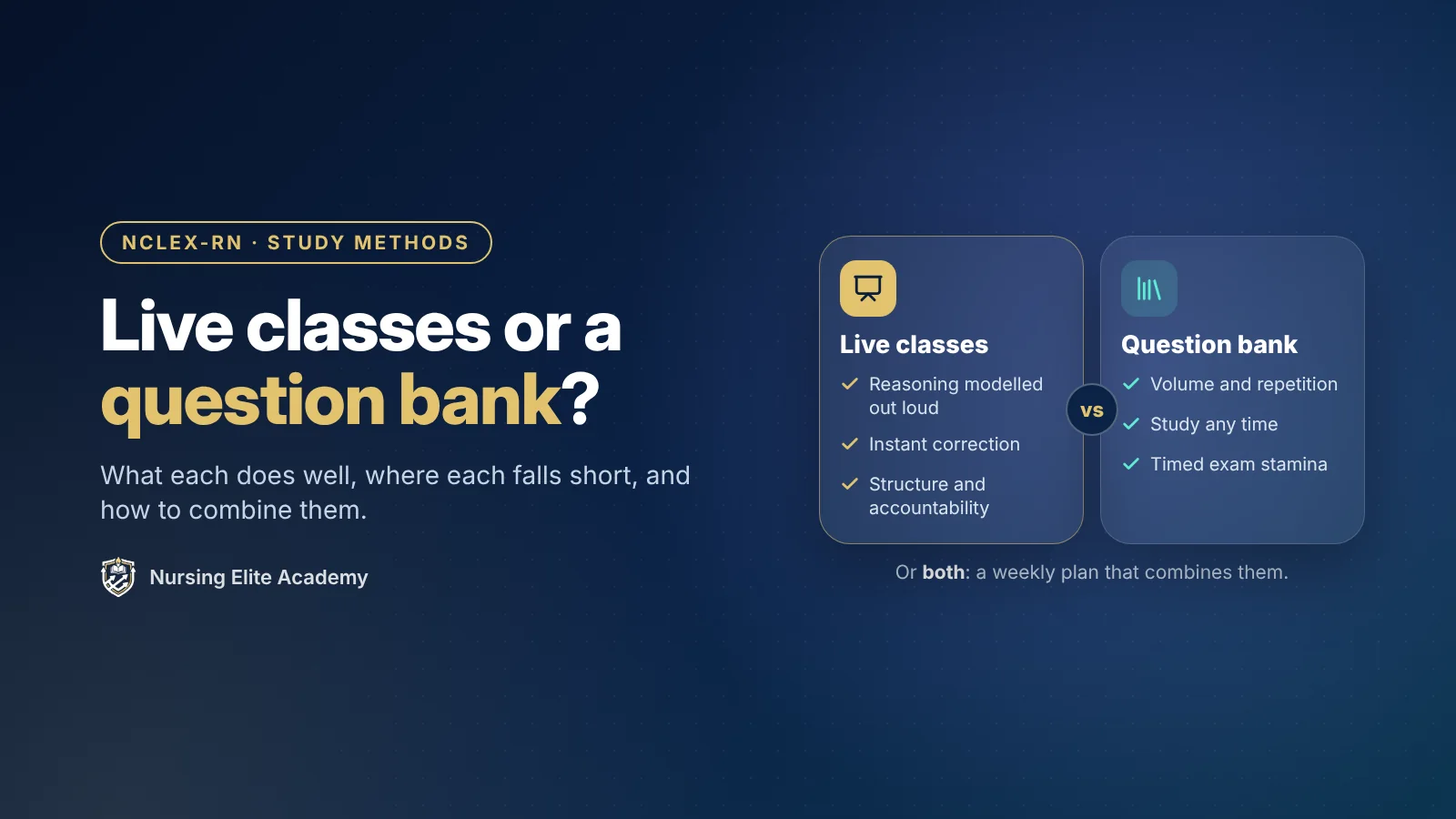
If you are preparing for the NCLEX-RN, you will hit the same fork in the road almost every candidate does: should you sign up for live classes, or buy a question bank and study on your own? Both are popular, both can work, and both can fail you if they do not match how you learn. The Next Generation NCLEX makes the choice more important than it used to be, because the exam now measures clinical judgment through case studies and new item types rather than recall alone. This guide compares NCLEX-RN live classes vs a question bank honestly: what each one is good at, where each one falls short, and how to decide, or combine them, based on your timeline, your weak areas and the way you study best.
What the NCLEX-RN actually asks of you
Before comparing study tools, it helps to be clear about the exam itself. Under the NCLEX-RN Test Plan effective April 2026, you answer between 85 and 150 items in a five-hour window that includes all breaks. A minimum-length exam includes three clinical judgment case studies of six items each, and stand-alone clinical judgment items such as bowtie and trend items make up roughly 10% of the exam. Fifteen items are unscored pretest items that you cannot identify.
The case studies and stand-alone items are built on the NCSBN Clinical Judgment Measurement Model, which breaks clinical thinking into six steps: recognize cues, analyze cues, prioritize hypotheses, generate solutions, take action and evaluate outcomes. Many items also earn partial credit, and on select-all-that-apply items an incorrect choice subtracts a point. In short, the exam rewards two things at once: a wide base of nursing knowledge, and the ability to reason through a changing client situation under time pressure. Any study plan has to build both.
What a question bank does well
A question bank is a large library of practice items with answers and rationales, usually with timed tests, performance reports and some form of readiness estimate. Used well, it is one of the most efficient study tools available.
- Volume and repetition. You can work through hundreds or thousands of items, which builds familiarity with item wording, distractors and the NGN formats.
- Flexibility. You can study at 5 a.m. before a shift or at midnight after the children are asleep, in sessions as short as 15 minutes.
- Exam stamina. Timed, full-length practice exams train the pacing and focus you need for a five-hour test.
- Data. Performance by Client Needs category shows you, in numbers, where you are losing points.
- Rationales. A good rationale explains why the right answer is right and why each distractor is wrong, which is where most of the learning happens.
Where a question bank falls short
The weakness of a question bank is that it cannot see how you think. It records that you chose option C, not why. If you keep missing priority questions because you jump to an action before analyzing the cues, the bank will keep marking you wrong without telling you that the problem is your process rather than your content knowledge.
- It is easy to drift into doing questions for the score, skimming rationales and repeating the same mistakes.
- Self-study needs strong discipline. Without a schedule or anyone checking in, many candidates stall halfway through.
- Content gaps stay hidden. If you never really understood fluid and electrolyte balance, answering more questions will not fix it on its own.
- Case studies are hard to learn alone. Six linked items reward a consistent line of reasoning, which is easier to build when someone models it for you.
What live classes do well
Live classes are scheduled, instructor-led sessions, usually online, where a nurse educator teaches content, works through questions in real time and answers your questions as they come up. Their strength is the part a question bank cannot provide: feedback on your reasoning.
- Thinking out loud. Watching an experienced nurse walk through a case study, step by step through the clinical judgment model, shows you what good reasoning sounds like.
- Immediate correction. When you explain your answer and the instructor asks why, flawed logic surfaces quickly.
- Structure and accountability. A fixed class time keeps you moving, which matters if you are studying around shifts, family or a move to a new country.
- Context. Internationally educated nurses often benefit from discussion of Canadian practice norms, scope and communication that a rationale does not always explain.
- Motivation. Studying alongside other candidates makes a long preparation period feel less isolating.
Where live classes fall short
- Fixed times. If your shifts rotate, you may miss sessions unless recordings are available.
- Less volume. A class covers fewer items per hour than self-paced practice, so classes alone rarely give you enough repetition.
- One pace for the group. The class may move faster than you need on a weak topic, or slower on one you already know.
- Passive attendance. Sitting through a class without doing practice afterwards gives a feeling of progress that does not always show up in your scores.
Live classes vs a question bank: a side-by-side view
- Best for building knowledge breadth: question bank, through volume and rationales.
- Best for building clinical judgment: live classes, through modelled reasoning and feedback, reinforced with case study practice.
- Best for flexibility: question bank.
- Best for accountability: live classes.
- Best for exam stamina and pacing: question bank, using timed full-length tests.
- Best for fixing a stubborn pattern of mistakes: live classes or one-on-one coaching.
How to decide what you need
Ask yourself these questions honestly. The more you answer yes, the more you are likely to benefit from live teaching alongside your practice questions.
- Have your practice scores been flat for two weeks or more despite doing more questions?
- Do you often narrow it down to two options and then pick the wrong one?
- Do NGN case studies feel confusing even when you know the content?
- Have you been away from clinical practice or nursing school for some time?
- Did you train outside Canada and want help with Canadian practice context?
- Have you written the NCLEX-RN before and need a different approach this time?
- Do you find it hard to stick to a self-study schedule?
If you answered no to most of them, you are scoring steadily and you study well on your own, a question bank with a clear plan may be enough. Keep an eye on your trend. If it plateaus, add structured teaching then rather than waiting until a few weeks before the exam.
A sample weekly plan that combines both
Here is one way to blend the two over a typical week while working. Adjust the numbers to your schedule and your exam date.
- Two live classes a week, each followed the same day by 20 to 30 practice items on the topic covered.
- Three or four self-study sessions of 45 to 60 minutes using the question bank, focused on your two weakest Client Needs categories.
- One NGN case study set worked slowly, writing out each clinical judgment step before checking the rationale.
- One timed practice test every week or two, increasing in length as your exam date approaches.
- Fifteen minutes at the end of each session reviewing every item you got wrong or guessed, and noting the reason in a mistake log.
Keep a mistake log
Whichever tools you use, write down why you missed each item: a content gap, misreading the question, choosing an action before an assessment, over-selecting on a select-all-that-apply item, or running short on time. After two weeks, the pattern tells you exactly what to bring to your next class or coaching session.
Questions to ask before you choose a program
- Are classes led by a registered nurse with teaching experience?
- Do classes cover NGN case studies and the clinical judgment model, not just traditional multiple choice?
- Are the practice items written in NGN formats with full rationales for every option?
- Can you see your performance by Client Needs category?
- Are sessions recorded if you miss one because of a shift?
- Will you get a personal study plan built backwards from your exam date?
- Can you try it before committing?
A free trial is the simplest way to answer the last question. Spend a few days with the practice items and see whether the rationales actually teach you something you did not know. Our guide to Next Generation NCLEX tips covers the case study format in more depth if you want to know what to look for.
- NCLEX-RN coaching at Nursing Elite Academy Live online classes plus the student portal
- Next Generation NCLEX (NGN) tips Case studies and the clinical judgment model
- Start your NCLEX-RN free trial
Sources
Frequently asked questions
Is a question bank enough to pass the NCLEX-RN?
For some candidates, yes, especially those who score steadily, review rationales carefully and keep to a schedule. If your scores plateau, you repeatedly choose between two options and pick the wrong one, or case studies feel confusing, adding live teaching or coaching usually helps more than adding more questions.
Are live NCLEX-RN classes worth it for internationally educated nurses?
They often are, because a live instructor can explain Canadian practice context, scope and communication expectations that a written rationale may not cover, and can correct reasoning patterns in real time. Combine classes with regular practice questions for the best results.
How many practice questions should I do alongside live classes?
There is no official number. A practical approach is 20 to 30 items on the topic of each class the same day, plus several longer self-study sessions each week and regular timed practice tests. Focus on reviewing every rationale rather than chasing a daily total.
Do I need to practise NGN case studies separately?
Yes. Under the 2026 test plan, a minimum-length NCLEX-RN includes three case studies of six items each, so practise full case studies, not just single items, and work through each clinical judgment step deliberately.
Ready for your next nursing role?
Get a professionally written Canadian nursing resume, interview preparation and practical career guidance from Nursing Elite Academy.
Get Your Resume BuiltMore guides for nurses
- NCLEX-RNNCLEX-RN Quiz Builder & 7-Day Free Trial | Nursing Elite Academy
- NCLEX-RNHow to Pass the NCLEX-RN in 2027 (Canada & India Guide)
- NCLEX-RNBest NCLEX-RN Prep: Why Nurses Choose Nursing Elite Academy
- PSWNACC PSW Exam: Format, Pass Mark and How to Prepare
- NCLEX-RNHow NCLEX-RN Scoring Works (CAT, Partial Credit, Stopping Rules)
- REx-PNREx-PN vs NCLEX-PN for Ontario and BC Practical Nurses
- NCLEXNGN NCLEX Tips: How to Prepare for the NCLEX-RN in Canada
- InterviewsCommon RPN Interview Questions and How to Answer Them
- ResumesNursing Resume Tips for Canada (RN, RPN & PSW)
- Internationally Educated NursesIEN Guide to Working as a Nurse in Canada
- GuidesHow to Verify a Registered Nurse in Canada