
PSW
NACC PSW Exam: Format, Rules and How to Prepare
By Nursing Elite Academy · · 8 min read
If you are studying in a Personal Support Worker program at an Ontario career college, there is a good chance your program uses the National Association of Career Colleges (NACC) curriculum, and that your certificate depends on one final step: the NACC PSW exam. It is the last hurdle after months of theory and two placements, and it can feel high stakes because the number of attempts is limited. The good news is that the exam tests the same theory you have already been taught. This guide explains how the NACC PSW exam works, what the official rules say about the pass mark and rewrites, what content to review and how to build a short, realistic study plan around placements and work.
What is the NACC PSW exam?
The NACC PSW exam, officially the NACC final theory examination, is an online exam that NACC uses to evaluate the theory component of its Personal Support Worker program. NACC describes its purpose as determining whether a candidate has the knowledge needed to do the job safely and effectively. The exam is set and marked externally by NACC rather than by your instructors, which is meant to give every student the same, unbiased standard.
The NACC program itself is 700 hours and is based on the Ontario Personal Support Worker Training Standard released in January 2022. Colleges that deliver it commonly list about 400 hours of theory and 300 hours of placement. Ontario's PSW standard applies to public colleges, private career colleges and district school boards, so the core content is similar wherever you train. If your program is delivered by a public college or school board instead, your final assessment may be different, so always confirm with your program.
When you write it
According to NACC, all students write the final theory examination after completing both placements. You do not book it yourself through NACC: your college schedules it, so speak with your college representative about your date. NACC's final exam policy, as published by member colleges, says you can write it only after you have finished all modules, tests, performance demonstrations and placement hours. Some colleges set their own timing within those rules, so your college's schedule is the one to follow.
NACC PSW exam format
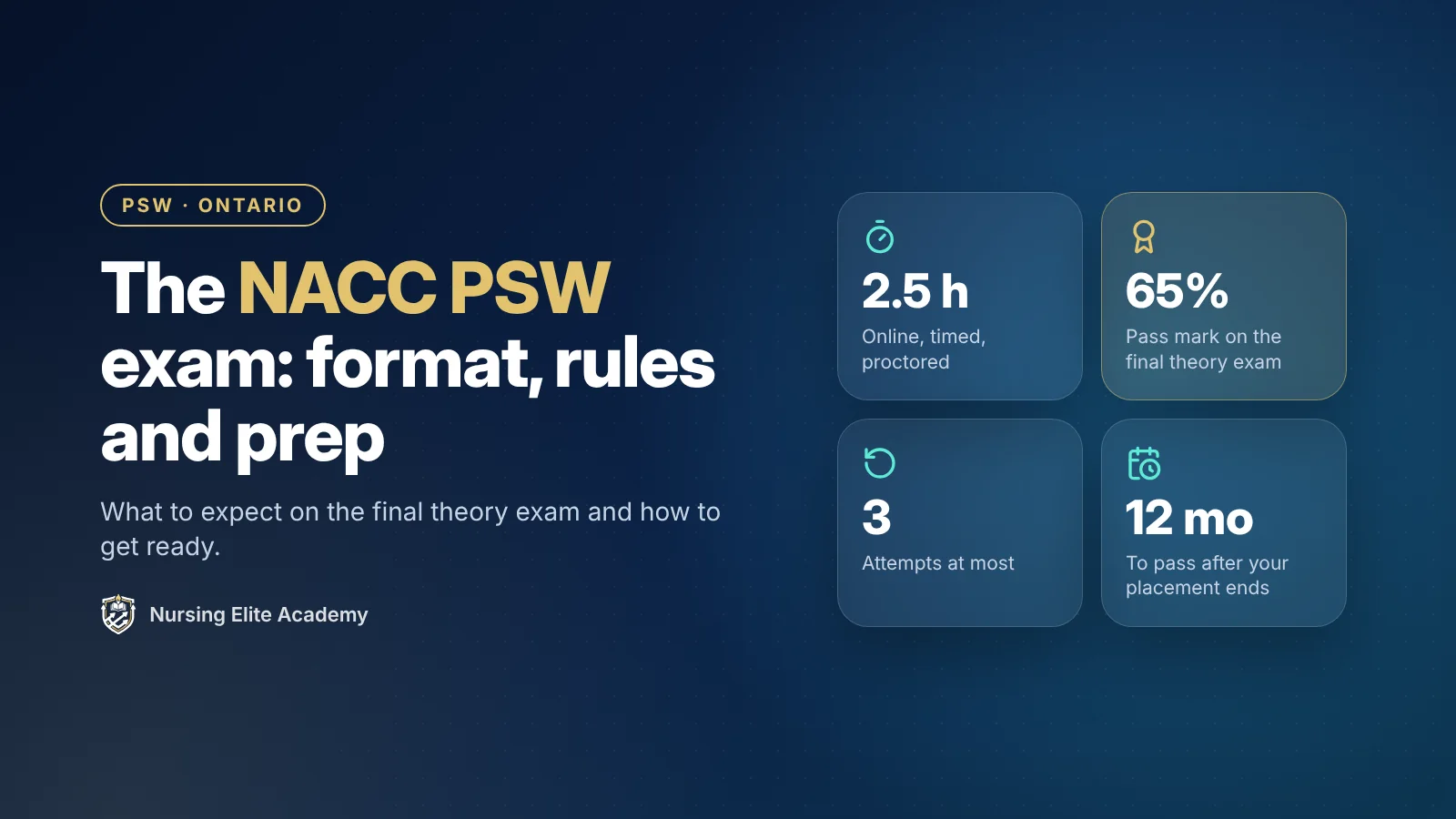
- Online and timed. The exam is completed on a computer and submits automatically when time runs out. The NACC final exam policy published by member colleges sets the time at 2.5 hours.
- Proctored and invigilated. The policy describes online proctoring together with an in-room invigilator who is not one of your program instructors.
- Closed book. Notes, phones, pens, paper and earbuds are not allowed in the exam room.
- Computer-marked. Grading happens automatically once you submit.
- Theory-based. It tests the knowledge behind safe personal support, much of it through client scenarios.
NACC does not publish an official question count on its program page, so be cautious with numbers you see online. Your college can confirm the current exam details before you write.
Pass mark, rewrites and deadlines
The NACC final exam policy and member college program pages state a pass grade of 65% on the final comprehensive theory exam. Your college may also require higher marks in individual courses during the program, which is a separate requirement.
- Attempts: the policy allows a maximum of three attempts. Ask your college how rewrites are scheduled.
- Before the third attempt, the college must submit a training plan to NACC and confirm you completed it.
- Deadline: the exam must be passed within 12 months of completing your practical placement.
- No appeal of a failing grade is available under the policy.
- If you do not pass within the allowed attempts, the policy requires you to register again as a new student and complete the full program before writing the exam again.
When you pass, NACC issues a digital credential, and your college receives a copy. Keep it safe, because employers commonly ask for proof of your PSW certificate.
What content to review
NACC's learning outcomes follow the Ontario standard. Organize your review around these areas rather than trying to reread every chapter.
- Activities of daily living: bathing, grooming, oral care, toileting, dressing, positioning and skin care.
- Household management and nutrition: meal assistance, special diets, feeding safety and swallowing precautions.
- Person-centred care: dignity, privacy, cultural safety, consent, client rights and respectful communication.
- Health and safety: infection prevention and control, hand hygiene, personal protective equipment, body mechanics, safe transfers and lifts, falls prevention and emergencies.
- Observing, documenting and reporting: what changes to report, to whom and how quickly.
- Working in a team: role and scope of a PSW, following the care plan and when to ask a regulated health professional.
- Specialized support: dementia care, mental health, palliative care and supporting a dying person and their family.
Know your scope
Many exam scenarios turn on one question: is this within a PSW's role? If a situation calls for assessment, diagnosis or a change to the care plan, the safe answer is usually to observe, keep the client safe and report promptly to the nurse or supervisor. Learn the difference between what you observe and report, and what a regulated health professional decides.
Two practice questions with rationales
These original examples show the scenario style you can expect. Read the question, choose an answer, then check the rationale.
Question 1. You arrive to help a client with morning care and notice a new reddened area over their tailbone that does not fade after you relieve the pressure. What should you do first? (A) Massage the area firmly to improve circulation. (B) Apply a cream from the client's bathroom. (C) Reposition the client off the area and report it to the nurse or supervisor. (D) Wait until the next visit to see if it improves.
Rationale: C is correct. Persistent redness can be an early sign of skin breakdown. Relieve the pressure, keep the client comfortable and report the change promptly so a regulated professional can assess it. Massaging a reddened area can cause further damage, applying products not in the care plan is outside your role, and waiting delays care.
Question 2. A client with dementia becomes upset during bathing and pushes your hand away. What is the best response? (A) Finish the bath quickly before the client gets more upset. (B) Stop, speak calmly, and try again later or in a different way. (C) Ask another worker to hold the client's arms. (D) Tell the client they must cooperate.
Rationale: B is correct. Responsive behaviours are often a form of communication, such as fear, cold or discomfort. Pausing, approaching calmly and adapting the task respects the client's dignity and keeps everyone safe. Forcing care or restraining the client is unsafe and disrespectful.
A four-week study plan
Most PSW students are balancing placement shifts, work and family. Short, regular sessions work better than long weekend cramming.
- Week 1: review safety, infection control and body mechanics, then answer 15 to 20 practice questions a day on those topics.
- Week 2: personal care, nutrition and mobility, with a focus on what to observe and report.
- Week 3: dementia, mental health, palliative care and communication, using scenario questions.
- Week 4: mixed practice tests under a 2.5-hour time limit, plus a review of every question you got wrong and why.
In each session, explain the reason for your answer out loud before checking it. If you cannot explain it, you are guessing, and that is the topic to review next.
Exam day tips
- Confirm the time, location and ID requirements with your college a few days ahead.
- Arrive early and leave phones and notes outside the exam room.
- Read every scenario for the client's safety first, then their dignity and independence.
- Watch for words such as first, best and most appropriate, and choose the answer that fits a PSW's role.
- Pace yourself and do not spend too long on any one question, because the exam submits automatically when time is up.
- NACC PSW exam prep at Nursing Elite Academy Theory review, practice questions and a study plan
- All exam prep programs
- Start your NACC PSW free trial
Sources
Frequently asked questions
What is the pass mark for the NACC PSW exam?
The NACC final exam policy and member college program pages state a pass grade of 65% on the final comprehensive theory exam. Confirm current rules with your college before you write.
How many times can I write the NACC PSW exam?
The NACC final exam policy allows a maximum of three attempts, and the exam must be passed within 12 months of completing your placement. Before the third attempt, your college must submit a training plan to NACC.
When do I write the NACC PSW exam?
NACC says all students write the final theory examination after completing both placements. Your college schedules the exam, so ask your college representative for your date.
Is the NACC PSW exam online?
Yes. It is a timed, closed-book online exam, proctored and invigilated at your college and marked automatically by computer.
What happens if I fail the NACC PSW exam three times?
Under the NACC policy, a student who does not pass within the allowed attempts must register again as a new student, complete the full program and then write the exam again.
Ready for your next nursing role?
Get a professionally written Canadian nursing resume, interview preparation and practical career guidance from Nursing Elite Academy.
Get Your Resume BuiltMore guides for nurses
- NCLEX-RNNCLEX-RN Quiz Builder & 7-Day Free Trial | Nursing Elite Academy
- NCLEX-RNHow to Pass the NCLEX-RN in 2027 (Canada & India Guide)
- NCLEX-RNBest NCLEX-RN Prep: Why Nurses Choose Nursing Elite Academy
- NCLEX-RNNCLEX-RN Live Classes vs a Question Bank: Which Do You Need?
- NCLEX-RNHow NCLEX-RN Scoring Works (CAT, Partial Credit, Stopping Rules)
- REx-PNREx-PN vs NCLEX-PN for Ontario and BC Practical Nurses
- NCLEXNGN NCLEX Tips: How to Prepare for the NCLEX-RN in Canada
- InterviewsCommon RPN Interview Questions and How to Answer Them
- ResumesNursing Resume Tips for Canada (RN, RPN & PSW)
- Internationally Educated NursesIEN Guide to Working as a Nurse in Canada
- GuidesHow to Verify a Registered Nurse in Canada