
NCLEX-RN
How NCLEX-RN Scoring Works: CAT, Partial Credit and Stopping Rules
By Nursing Elite Academy · · 9 min read
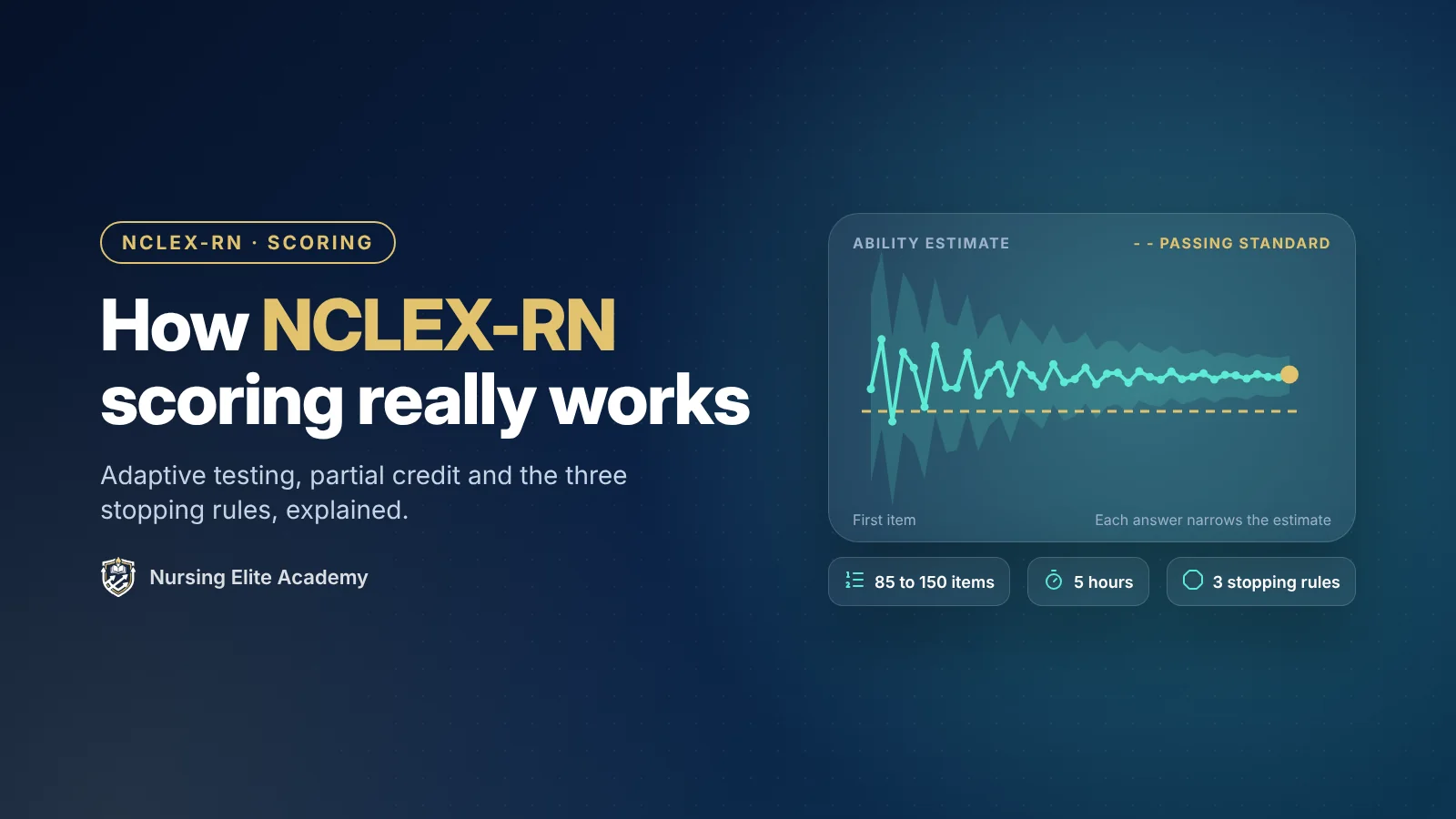
Almost every NCLEX-RN candidate asks the same questions after writing: why did my exam stop at 85 questions, did the hard questions mean I was doing well, and do I lose marks for a wrong option on a select-all-that-apply item? The answers all come from how NCLEX-RN scoring works. The exam is not marked like a school test with a percentage cut-off. It uses computerized adaptive testing (CAT), a fixed passing standard, partial credit on many items and three stopping rules. This guide explains each piece in plain language, using the 2026 NCLEX-RN Test Plan and official NCSBN information, so you can study with the scoring model in mind instead of guessing.
The short version
- The NCLEX-RN is a computerized adaptive test: each question is chosen based on how you answered the ones before it.
- Under the test plan effective April 2026, you answer a minimum of 85 and a maximum of 150 items, with a five-hour time limit that includes breaks.
- Fifteen items on every exam are unscored pretest items, and you cannot tell which ones they are.
- You pass by showing ability at or above the passing standard, not by reaching a percentage of correct answers.
- Items with more than one correct answer can earn partial credit under three scoring methods: plus/minus, zero/one and rationale.
- The exam ends under one of three stopping rules: the 95% confidence rule, the maximum-length rule or the run-out-of-time rule.
Computerized adaptive testing, explained
In a computerized adaptive test, the computer keeps a running estimate of your nursing ability. NCSBN describes it this way: after each item, the computer re-estimates your ability using all of your previous answers and the difficulty of those items, then selects the next item that will give it the most information about you. In practice, that means the questions are aimed at the edge of what you can do. If you answer correctly, the next item tends to be a little harder. If you answer incorrectly, the next one tends to be a little easier.
This is why most candidates walk out feeling that the exam was difficult. A well-targeted adaptive test is supposed to feel challenging for everyone, because it keeps searching for the level where you get roughly half the items right. Feeling stretched is not a sign that you failed, and noticing easier questions is not proof that you are failing either.
What the exam looks like in 2026
The 2026 NCLEX-RN Test Plan sets the exam at 85 to 150 items within five hours, including all breaks. A minimum-length exam is made up of 52 content-area items, 18 items that form three clinical judgment case studies of six items each, and 15 unscored pretest items. Stand-alone clinical judgment items, such as bowtie and trend items, make up roughly 10% of the exam depending on its length. If you want a refresher on the case study format and the clinical judgment model behind it, our guide to Next Generation NCLEX tips covers both.
The passing standard
The passing standard is the cut point that marks the minimum ability needed for safe and effective entry-level nursing practice. The NCSBN Board of Directors re-evaluates it every three years alongside the test plan. In December 2022 the Board voted to keep the NCLEX-RN passing standard at 0.00 logits, and NCSBN lists it as effective through March 31, 2029.
Two consequences follow. First, there is no fixed number or percentage of correct answers that guarantees a pass. Second, there is no quota: NCSBN states that no set percentage of candidates passes or fails. You are measured against the standard, not against the other people writing that day.
Partial credit: how multi-answer items are scored
Since the Next Generation NCLEX launched in 2023, items with more than one correct answer can earn partial credit. The test plan and the official NCLEX FAQs describe three scoring methods.
Plus/minus (+/-) scoring
Plus/minus scoring is used when you may select an unspecified number of options, which is the familiar select-all-that-apply format. You earn a point for each correct option you choose and lose a point for each incorrect option you choose. The item score cannot drop below zero. The practical lesson: selecting every option just to be safe costs you points. Choose each option on its own merits, as if it were a true-or-false statement.
Zero/one (0/1) scoring
Zero/one scoring is used when the item tells you how many responses to choose, such as select two or select five, and for many drop-down and cloze-style items. Each correct response earns a point and incorrect responses earn nothing, so there is no deduction. The item total is the sum of your correct responses. Because nothing is subtracted, always fill in every required response rather than leaving one blank.
Rationale scoring
Rationale scoring is used for closely paired information, such as a cause and its effect, or a finding and the condition it supports. Both parts of the pair must be correct to earn the point. If you pick the right condition but link it to the wrong reason, you earn nothing for that pair. These items reward reasoning that connects assessment data to a conclusion, not memorized lists.
The three stopping rules
Your exam ends when one of three rules is met. The rules apply in the same way to every candidate.
- The 95% confidence interval rule. This is the most common way an exam ends. Once you have answered at least the minimum number of items, testing stops as soon as the computer is 95% certain that your ability is clearly above or clearly below the passing standard.
- The maximum-length rule. If your ability is very close to the passing standard, the computer keeps asking items until you reach the maximum. At that point the 95% rule no longer applies, and your final ability estimate decides the result: at or above the standard is a pass, below it is a fail.
- The run-out-of-time (R.O.O.T.) rule. If time runs out before the computer has reached a decision, two things can happen. If you have not answered the minimum number of items, the result is a fail. If you have answered at least the minimum, your final ability estimate, based on every response you gave, decides the result.
Notice what the run-out-of-time rule means for pacing. Running out of time before reaching the minimum number of items is an automatic fail, so budget your time from the start. With five hours and a maximum of 150 items, a steady pace that leaves room for case studies and a short break is far safer than lingering on a single item.
Myths about NCLEX-RN scoring
- Shutting off at 85 means you passed. Not necessarily. The exam can stop at the minimum because the computer is confident you are clearly above or clearly below the standard.
- Going to 150 means you failed. Also not true. A full-length exam simply means your ability was close to the standard, and many candidates pass at the maximum.
- Lots of select-all-that-apply items means you are doing well. NCSBN states there is no predetermined percentage of item formats, so the mix of item types tells you nothing about your result.
Getting your result in Canada
Official results come only from your nursing regulator, not from Pearson or NCSBN. For Ontario candidates, the College of Nurses of Ontario says it usually sends results through its online application portal within about a week. In British Columbia, results come from BCCNM. The unofficial Quick Results service described on the NCLEX website is offered only for U.S. licensure candidates whose regulator participates.
If you do not pass, you receive a Candidate Performance Report showing whether you performed above, near or below the passing standard in each content area. NCSBN policy allows a retake 45 days after your previous attempt, with up to eight attempts a year, though a regulator can set a stricter rule. CNO, for example, says you can write once in any 45-day period and must meet all registration requirements within two years of applying.
How to use this when you study
- Practise under adaptive or timed conditions so the feeling of hard questions becomes normal rather than alarming.
- Train selection discipline on select-all-that-apply items, because over-selecting is penalized under plus/minus scoring.
- Work full case studies, not just single items, so you get used to linking cues, hypotheses and actions across six questions.
- Track your weakest Client Needs categories, such as Management of Care (15 to 21% of the 2026 exam) and Pharmacological and Parenteral Therapies (13 to 19%), and plan review time around them.
- Rehearse pacing for five hours, including when you will take a break.
- NCLEX-RN coaching at Nursing Elite Academy
- Next Generation NCLEX (NGN) tips Case studies and the clinical judgment model
- Start your NCLEX-RN free trial
Sources
Frequently asked questions
How many questions are on the NCLEX-RN in 2026?
Under the test plan effective April 2026, the NCLEX-RN has a minimum of 85 and a maximum of 150 items, including 15 unscored pretest items and three clinical judgment case studies. The time limit is five hours, including breaks.
Does the NCLEX-RN give partial credit?
Yes. Items with more than one correct answer can earn partial credit using plus/minus, zero/one or rationale scoring. On select-all-that-apply items, incorrect selections subtract points, but an item score cannot go below zero.
If my NCLEX stopped at 85 questions, did I pass?
Not necessarily. The exam stops at the minimum when the computer is 95% confident your ability is clearly above or clearly below the passing standard, so stopping early can mean either result.
What percentage do you need to pass the NCLEX-RN?
There is no passing percentage. You pass when your final ability estimate is at or above the passing standard, which NCSBN has kept at 0.00 logits for the NCLEX-RN through March 31, 2029.
How long do I wait to retake the NCLEX-RN in Canada?
NCSBN policy allows a retake 45 days after your previous attempt, with up to eight attempts a year. Your regulator may set stricter rules; the College of Nurses of Ontario allows one attempt in any 45-day period.
Ready for your next nursing role?
Get a professionally written Canadian nursing resume, interview preparation and practical career guidance from Nursing Elite Academy.
Get Your Resume BuiltMore guides for nurses
- NCLEX-RNNCLEX-RN Quiz Builder & 7-Day Free Trial | Nursing Elite Academy
- NCLEX-RNHow to Pass the NCLEX-RN in 2027 (Canada & India Guide)
- NCLEX-RNBest NCLEX-RN Prep: Why Nurses Choose Nursing Elite Academy
- PSWNACC PSW Exam: Format, Pass Mark and How to Prepare
- NCLEX-RNNCLEX-RN Live Classes vs a Question Bank: Which Do You Need?
- REx-PNREx-PN vs NCLEX-PN for Ontario and BC Practical Nurses
- NCLEXNGN NCLEX Tips: How to Prepare for the NCLEX-RN in Canada
- InterviewsCommon RPN Interview Questions and How to Answer Them
- ResumesNursing Resume Tips for Canada (RN, RPN & PSW)
- Internationally Educated NursesIEN Guide to Working as a Nurse in Canada
- GuidesHow to Verify a Registered Nurse in Canada